
Planning your first classes during yoga teacher training
Your first practice-teaching slots are short, nerve-racking and incredibly useful. A little planning structure makes them calmer for you and clearer for the people practicing with you.
Plan smaller than you think
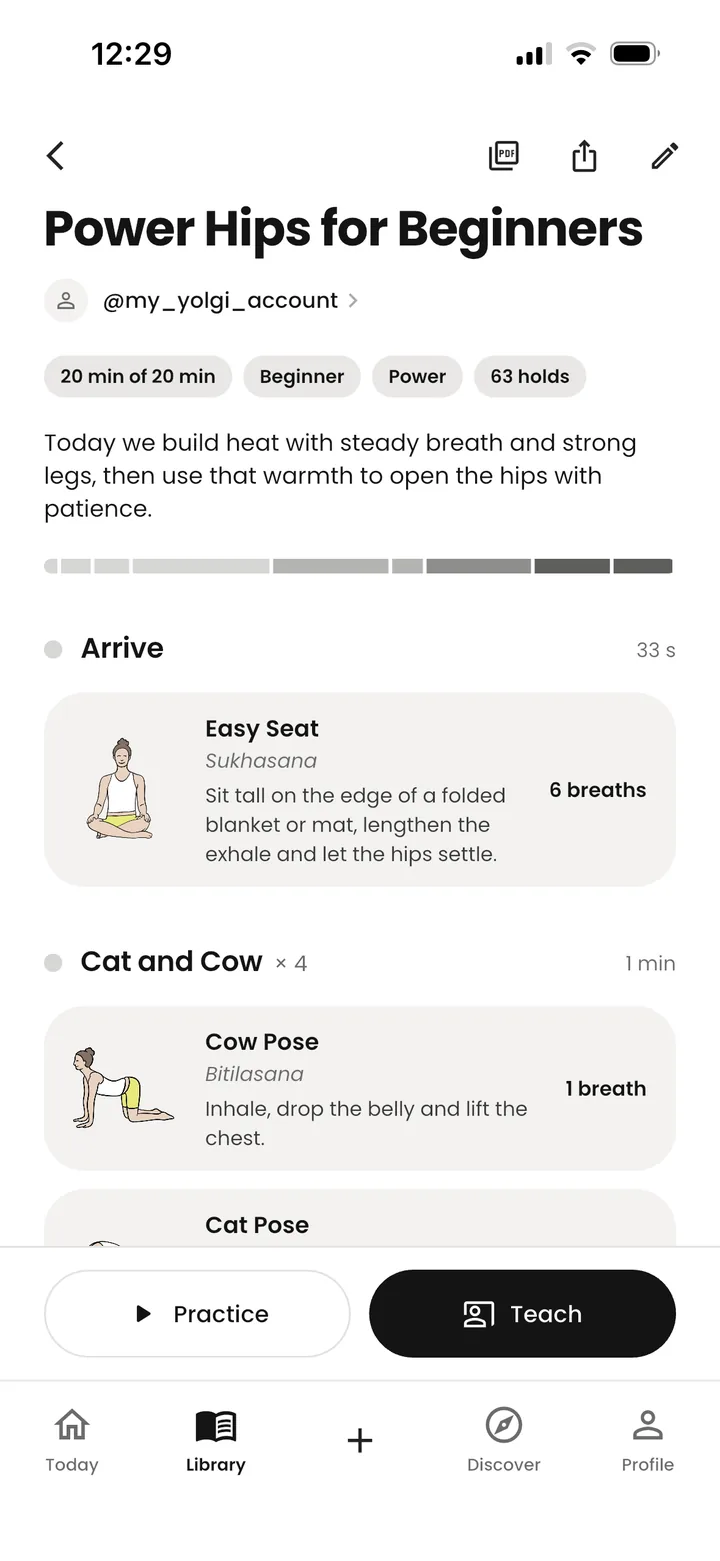
New teachers almost always plan too much. Twenty minutes feels long on paper and short in the room, because cueing, demonstrating and waiting for people takes time. For a first 20-minute slot, aim for 8 to 12 poses. You'll be surprised how full it feels.
Script the first and last five minutes
Nerves are highest at the start and attention is lowest at the end. Write out the opening and closing word for word:
- Opening: your name, one sentence of intention, and the first pose. “Let's begin in a comfortable seat.”
- Closing: the cue into rest, and how you'll bring people back. You'll be glad not to improvise this part.
The middle you can teach from a list, but those ten minutes deserve a script.
Choose poses you can teach, not just do
A pose you can do beautifully isn't necessarily a pose you can teach yet. In early practice teaching, choose poses whose setup you can describe from the ground up without demonstrating. If you can't write its first cue in one sentence, save it for later.
Plan to the minute and check it
Add up your holds honestly: roughly 5 seconds per breath, a few seconds per transition, both sides for one-sided poses. Then teach the class to an empty room with a timer running. Many trainees find their real class runs noticeably longer than the plan, and it's better to discover that alone than mid-class.
Keep a sequencing journal
Every class you plan during training is material for later. Keep them, with notes on what worked. By the end of your training you'll have a library of tested sequences instead of a stack of loose pages. Group them by focus (hips, backbends, balance, gentle) so you can find them when you start teaching for real.
Ask for feedback you can use
“That was great!” is kind but not useful. Ask fellow trainees two specific questions after you teach:
- Which cue was clearest, and which one did you have to look around to understand?
- Where did the class feel rushed, and where did it drag?
Write the answers next to your plan straight away, while you still remember the class.
For trainers: make planning visible
If you lead a training, ask trainees to share their plans before they teach. Reviewing a sequence is faster than reviewing a class, and you can spot missing counterposes or uneven sides before they reach the room. Sharing example classes from your own teaching shows trainees what a finished plan looks like.
Next, read our step-by-step guide on how to sequence a yoga class.